How to Light a Reading Corner: Lamps, Height and Warmth
A good reading corner needs one focused light beside the shoulder, a softer light in the room behind it, and a warm 2700K to 3000K glow. Here is how to place each one.
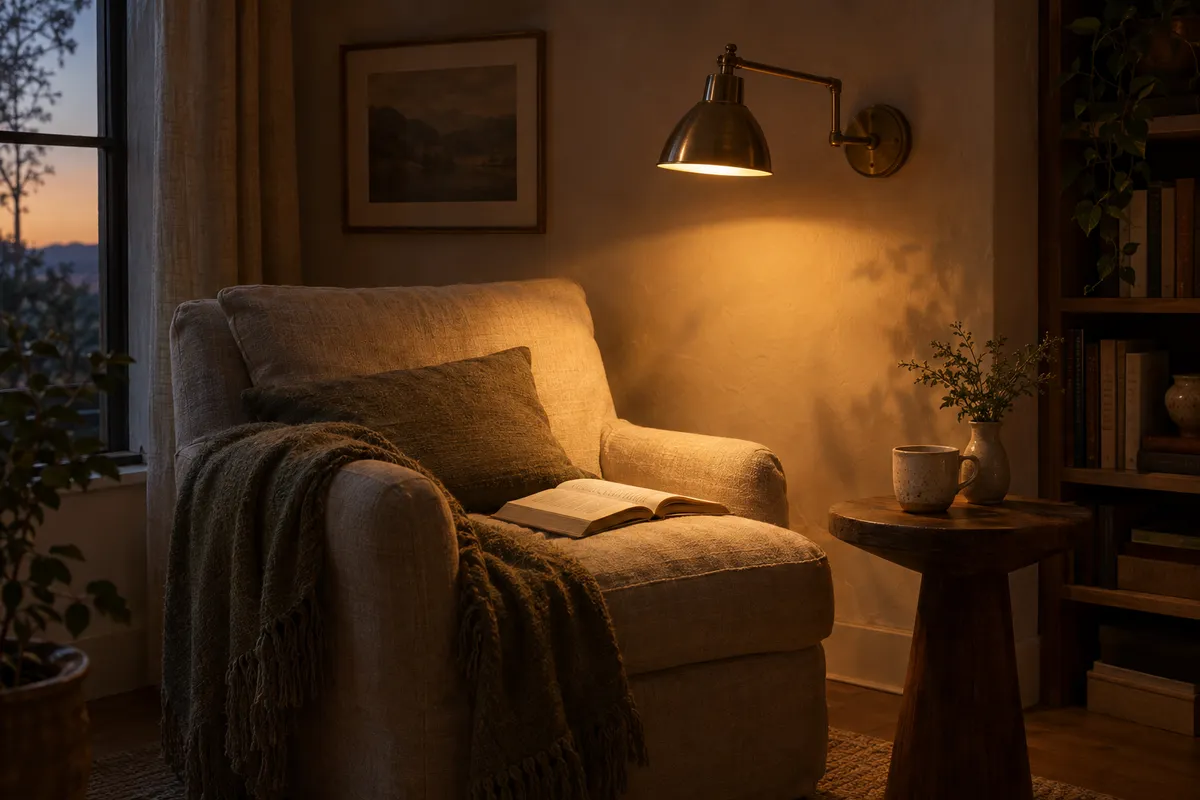
In short
- Put the reading light beside and slightly behind your shoulder, on the side opposite the hand you turn pages with, so your arm never casts a shadow on the page.
- Aim for the bottom of the shade or the light source to sit roughly at shoulder height when you are seated, which keeps the bulb out of your eyes.
- Use a warm white between 2700K and 3000K for evening reading, and a dimmer so the same lamp can go from focused to soft.
- Add a second, gentler light elsewhere in the room so the bright page is not the only lit thing in a dark space.
- Plug-in swing-arm sconces give renters a wall-mounted reading light with no electrician and no lost floor space.
A reading corner is a small place with a precise job. The light has to land on the page, stay out of your eyes and leave the rest of the room calm enough to settle into. Get the position and the warmth right and an ordinary armchair becomes the best seat in the house. Get them wrong and you end up squinting under a ceiling light that flattens everything.
There are three decisions to make: which kind of light does the reading, where exactly it goes, and how warm and bright it should be. The rest is style.
Choose the light that does the reading
Reading light is task light: concentrated, directional and close. Three fixtures do it well, and the right one depends mostly on your walls and your floor space.
| Fixture | Best when | Watch for |
|---|---|---|
| Swing-arm wall sconce | Space beside the chair is tight, or you want the floor clear | Mount it so the arm reaches past the chair's edge |
| Arc or adjustable floor lamp | The chair floats in the room or you rent and cannot drill | A heavy base, so the arc stays put when you swing it |
| Clip-on book light | Reading in bed or travelling, or sharing a room at night | Too small to light the room; pair it with a soft lamp |
Swing-arm sconces: a wall-mounted light, no electrician
A swing-arm sconce folds flat against the wall when you are done and swings out over your shoulder when you sit down. That reach is the whole point: the light comes to the book instead of the book going to the light. Plug-in versions run their cord down the wall to an outlet, so they suit rentals and rooms where nobody wants to open a wall. Look for a fabric or metal shade that hides the bulb from a seated eye, a switch on the base or cord you can reach without standing, and a dimmer if you read late.
Plug-in swing-arm sconces
Each mounts with two screws and plugs into a standard outlet; several come as pairs for either side of a sofa or bed.


A matched pair for a sofa or a bed
Two identical arms with soft white fabric shades and black wall plates: one for each side of a sofa, or one per reader in a shared bed. The shade covers the bulb completely from a seated angle, which is what makes a sconce comfortable for long reading.
- Arm folds back flat against the wall
- Fabric shade diffuses the light around the page
- Plug-in cord, so it works in a rental
Floor lamps: an arc over the chair, or a head you can aim
If the chair sits away from a wall, a floor lamp is the reading light. An arc floor lamp curves its shade out and over the seat, so the light falls from above and slightly behind, much like a sconce. An adjustable-height or gooseneck lamp lets you aim the head exactly where the book sits, which suits crafts and fine work as much as novels. Torchiere lamps with a separate reading arm do two jobs at once: an upward wash for the room and a directed beam for the page.
Floor lamps that reach over a chair
Arcs, adjustable heads and a torchiere with its own reading arm.


The classic reading arc
A matte black arc with a linen drum shade that hangs over the chair rather than beside it, so the light falls across the page from above. It is dimmable, which lets one lamp move from focused reading light to a low evening glow.
- Linen shade softens the light on the page
- Dimmable for late reading
- Arc clears the side of the chair
Where the light goes: height, side and distance
Most reading corners fail on placement, not on the lamp. Three rules cover nearly every chair.
- Side: place the light on the side opposite the hand you turn pages with. Right-handed readers usually want it on the left, so the turning arm never shadows the page.
- Height: when you sit, the bottom of the shade should land roughly at your shoulder, a little above your eye line. Higher and the light spreads thin; lower and the bulb glares.
- Distance: keep the source about an arm's length from the page and slightly behind you, so it lights the book and not your face.
For a sconce, that usually means mounting the wall plate a little above the height of the chair's back when the arm is extended. Sit in the chair, hold the book where you read it, and have someone mark the spot before you drill. These are design guidelines, not installation rules: anything you hardwire is a job for a licensed electrician.
Warmth and brightness: 2700K, 3000K and dimmers
Colour temperature is measured in kelvin (K). Lower numbers look warmer and more golden, higher numbers look whiter and bluer. For evening reading in a living room or bedroom, 2700K to 3000K feels like lamplight and matches most other bulbs in a home. Cooler light around 4000K reads crisper and suits detailed daytime work, but it can make a cosy corner feel like an office after dark.
Brightness is about lumens, not watts. A reading lamp wants enough output to make print sharp without bouncing glare off glossy pages, and a dimmer is the easiest way to find that point for your own eyes and your own room. Lamps that switch between colour temperatures let you read warm at night and cooler on a grey afternoon.
Layer the corner so the page is not the only light
Reading under one bright lamp in a dark room is tiring: your eyes keep adjusting between the bright page and the shadows around it. Add a second, softer layer somewhere else: a table lamp across the room, a picture light, or a ceiling light on low. The goal is a gentle glow around you and a brighter pool on the book.
In bed, or when someone else is asleep, a small clip-on book light does the reading while a sconce or lamp stays off. Rechargeable ones clip onto the cover and light only the page.
Book lights for reading in bed
Rechargeable, clip on the cover and light the page, not the room.


A reading corner in five steps
- Pick the chair and its spot first; the light follows the chair.
- Choose a plug-in sconce if the chair is against a wall, or a floor lamp if it is not.
- Set it on the side away from your page-turning hand, shade at about shoulder height.
- Use a warm 2700K to 3000K bulb and a dimmer.
- Add one soft light elsewhere in the room, or a book light for the bed.
Questions people ask
What is the best light for reading in a chair?
A directional light placed beside and slightly behind your shoulder: a swing-arm wall sconce or an arc or adjustable floor lamp. It should hide the bulb from your eyes and put a focused pool of light on the page.
How high should a reading lamp be?
When you are seated, the bottom of the shade should sit roughly at shoulder height, a little above eye level. That keeps the bulb out of your sight while the light still falls across the page.
Is warm or cool light better for reading?
For evening reading at home, warm white between 2700K and 3000K is the most comfortable and matches the rest of a living room or bedroom. Cooler light around 4000K looks crisper for detailed daytime work. A lamp with a dimmer or selectable colour temperature covers both.
Can I put a wall sconce in a rental?
Yes. Plug-in sconces mount with a couple of small screws and plug into an ordinary outlet, so nothing is wired into the wall. A cord cover painted the wall colour keeps it tidy.
Which side should a reading lamp go on?
The side opposite the hand you turn pages with. Right-handed readers usually place it on the left, so the turning arm never casts a shadow over the page.